Name
Thomas Walker Tortoishell
Conflict
First World War
Date of Death / Age
08/06/1917
Rank, Service Number & Service Details
Private
2405
Australian Pioneers
3rd
Awards: Service Medals/Honour Awards
Not Yet Researched
Cemetery/Memorial: Name/Reference/Country
ST. ALBANS (HATFIELD ROAD) CEMETERY
Mil. F. I.
United Kingdom
Headstone Inscription
Not Researched
UK & Other Memorials
Not on the St Albans memorials (*1)
Biography
Thomas Walker Tortoishell was born at Rocester, Staffordshire, England to parents Thomas & Lydia Tortoishell (nee Lines). His birth was registered in March quarter, 1882 in the district of Cheadle, Staffordshire, England. Thomas Walker Tortoishell was baptised on 9th April, 1882 at St. John the Evangelist Church, Hollington, Staffordshire, England.
The 1891 England Census recorded Thomas W. Tortoishell as a 9 year old Scholar living with his family at 40 Birchwood Rd, Kings Norton, Worcestershire, England. His parents were listed as Thomas Tortoishell (Note: Family surname recorded as “Tortoreshell” on the Census), (Bricklayer, aged 48, born Rocester, Staffordshire) & Lydia Tortoishell (aged 41, born Leamington, Warwickshire). Thomas W. Tortoishell was the eldest of three children listed on this Census (all born Hollington, Staffordshire) – Thomas then Lydia H. Tortoishell (Scholar, aged 7) & Maria J. Tortoishell (Scholar, aged 5).
The 1901 England Census recorded Thomas W. Tortoishell as a 19 year old Bricklayer, living with his family at 37 Newport Rd, Balsall Heath, Birmingham, England. His parents were listed as Thomas Tortoishell (Bricklayer, aged 59) & Lydia Tortoishell (aged 51). Thomas W. Tortoishell was one of four children listed on this Census – Cornelius Tortoishell (Bricklayer, aged 35), then Thomas W. , Lydia Tortoishell (Dressmaker, aged 17) & Maria J. Tortoishell (aged 15).
Thomas Walker Tortoishell married Louisa Ellen Albutt in the December quarter, 1901 in the district of King’s Norton, Worcestershire, England.
A daughter – Lydia Ellen Elsie was born on 13th August, 1902. She was baptised on 7th September, 1902 in St. Barnabas Church, Balsall Heath, Birmingham, England. Her parents were listed as Thomas Walker Tortoishell, Brick Layer & Louisa Ellen Tortoishell of 37 Newport Road. (**Interesting note – on Lydia Elsie Tortoishell’s Marriage Register in 1931 her father was listed as “Thomas Walker Tortoishell (deceased) Architect.”)
A daughter – Maisie Louisa Tortoishell was born on 30th April, 1904 in the district of Aston, Warwickshire, England. (** On Maisie Louise Tortoishell’s Marriage Register in 1926 her father was listed as “Thomas Walker Tortoishell (deceased) Bricklayer.”)
[The 1911 England Census recorded Louisa Tortoishell as remarried Louis Baggallay (aged 29), living with her husband – Arthur Baggallay (Carter, aged 29). They had been married for one year & had one child – Mary Baggallay who was aged 7 months. Also listed was Maisie Tortoishell (aged 6) – Louisa’s daughter & Arthur’s step daughter.]
Thomas Walker Tortoishell was a 34 year old, single, Bricklayer (apprenticed to Henry Gibbs for 7 years) from Hexham Hotel, Hexham, New South Wales when he enlisted on 1st February, 1916 at Casula, Sydney, New South Wales with the Australian Imperial Force (A.I.F.). His religion was Church of England & his next of kin was listed as his mother – Mrs Lydia Tortoishell, Sparkbrook, Birmingham, England (address as listed on Embarkation Roll, however her address was listed as 23 Strenshaw Road, Balsall Heath, Birmingham, England on Thomas Walker Tortoishell’s Attestation Papers).
Private Thomas Walker Tortoishell was posted to “D” Company at Depot, Casula, NSW on 1st February, 1916 for recruit training. He was transferred to “C” Company at Depot, Casula on 8th February, 1916. Private Tortoishell was written up on Conduct Sheet on 18th February, 1916 for being Absent without Leave from 6.30 am to 6 pm on 17th February, 1916. Punishment awarded – Admonished. He was transferred to 3rd Pioneer Battalion on 10th March, 1916 & was written up on Conduct Sheet on 16th March, 1916 while posted at Liverpool Camp, NSW – “Under the influence drink”. Punishment awarded – Admonished. Private Tortoishell was transferred on 23rd March, 1916 to “B” Company, 3rd Pioneer Battalion. He was transferred to Langwarrin (Victoria) on 26th April, 1916 with V.D. then on 3rd August, 1916 he was transferred to Seymour (Camp) on 3rd August, 1916. Private Tortoishell was admitted to No. 5 Australian General Hospital on 12th August, 1916. He rejoined 3rd Pioneer Battalion & was posted to 3rd reinforcements on 17th August, 1916.
Private Thomas Walker Tortoishell, Service number 2405, embarked from Melbourne, Victoria on HMAT Karroo (A10) on 18th September, 1916 with the 3rd Pioneer Battalion, 3rd Reinforcements. He was A.W.L. (Absent without Leave) on 19th October, 1916 at Cape Town. (The War Gratuity Schedule form recorded that Private Tortoishell was in No. 2 General Hospital, Maitland, Cape Town on 3rd November, 1916 with Scabies & was progressing favourably). Private Tortoishell re-embarked on Seang Choon at Cape Town on 10th November, 1916 & disembarked at Plymouth, England on 9th December, 1916.
Private Thomas Walker Tortoishell was written up for an Offence on 19th October, 1916 – “A.W.L. for 6 hrs 19.10.16.” He was awarded 168 hours Detention on 20th October, 1916 & a total forfeiture of 8 days pay.
Australian Engineers in the First World War
Engineers, also known as sappers, were essential to the running of the war. Without them, other branches of the Allied Forces would have found it difficult to cross the muddy and shell-ravaged ground of the Western Front. Their responsibilities included constructing the lines of defence, temporary bridges, tunnels and trenches, observation posts, roads, railways, communication lines, buildings of all kinds, showers and bathing facilities, and other material and mechanical solutions to the problems associated with fighting in all theatres.
(Description of Engineers Information from The Australian War Memorial)
3rd Pioneer Battalion
The 3rd Pioneer Battalion was an Australian infantry and light engineer unit raised for service during the First World War as part of the all volunteer Australian Imperial Force (AIF). Formed in Victoria in March 1916, the battalion subsequently undertook further training in the United Kingdom before arriving in France in late 1916. It later served on the Western Front in France and Belgium until the end of the war.
The 3rd Pioneers were raised in Victoria, in March 1916, from volunteers drawn from Victoria, Queensland, South Australia, and Western Australia and was subsequently assigned to the 3rd Division.
Trained as infantrymen, the pioneers were tasked with light combat engineer functions in the field, with a large number of personnel possessing trades from civilian life. The concept had existed within the British Indian Army before the war, but was adopted by the Australian Army in early 1916 to meet a need for troops with construction and engineering skills to assist with digging trenches, labouring, constructing strong points and undertaking battlefield clearance. As such, they were designated as pioneer units. At the same time, they could be pressed into the line to fight alongside regular infantry where required.
A total of five pioneer battalions were raised by the AIF during the war, with one being assigned to each of the five infantry divisions that the Australians deployed to the battlefield in France and Belgium. The battalions consisted of four companies, under a headquarters company. To identify the 3rd Pioneer Battalion's personnel, they were issued with a purple and white Unit Colour Patch. The colours were in common with other Australian pioneer battalions, while the horizontal oval shape denoted that the unit was part of the 3rd Division.
The battalion's first commanding officer was Lieutenant Colonel Robert Law, and upon establishment it was decided that the unit would be an "all States" unit, meaning that personnel would not just be drawn exclusively from one particular state, but would instead draw recruits from all around Australia. The headquarters and 'A' Company were recruited from Victoria, and was established at Ascot Vale, before moving to Campbellfield in March, while 'B' Company was composed of New South Welshmen, 'C' Company came from Queensland and 'D' Company was a composite sub-unit drawn from South Australia and Western Australia. After the sub-units had formed in their home locations – Liverpool, Bathurst, Brisbane, Blackboy Hill, and Adelaide – the battalion began concentrating at Campbellfield in April 1916.
Detailed training began at Campbellfield shortly after concentration and in May the battalion marched through the streets of Melbourne, before being presented with its unit colour. They were subsequently laid up at St Paul's Cathedral in Melbourne prior to embarkation. They departed Australia on the transport Wandilla on 6 June 1916, and endured a seven-week voyage to the United Kingdom, sailing via Cape Town. After arriving in the United Kingdom, the battalion subsequently concentrated with the rest of the 3rd Division around Larkhill on Salisbury Plain, in Wiltshire. Between July and November 1916, the 3rd Pioneers carried out intensive training to prepare them for their arrival on the Western Front. Finally, on 25 November the battalion entrained at Amesbury bound for Southampton from where they were ferried across the English Channel to Le Havre.
(Extract of Pioneer Battalion information from Wikipedia)
Private Thomas Walker Tortoishell was admitted to Endell Street Military Hospital, England on 22nd December, 1916. A progress report was made on 5th January, 1917 & he was reported to be seriously ill. The Hospital Admissions form recorded “Strain of ankle Joint; Delusional Insanity & wound of neck injuring larynx & small vessels.”
“21.12.16 : Reported sick while on Leave from Salisbury having strained ankle at Birmingham
22.12.16: Restless & anxious to get out. 5.15 pm discovered with throat cut; good deal of Haemorrhage, carotid intact. Operation – Litigation of bleeding joints. Wound left join. Has been getting drugs (unknown what) from chemist for 7 years for Sleeplessness. Has been heavy drinking. Syphilis 7 years ago.....Some bronchitis. Delusions – states ward to be full of his relatives who are trying to do for him. Says live wires are put through floor & holes cut in walls; that a scaffolding is put up to window to get at him, & that people try to inset (?) poison through his wound. That there are men on top of the cupboard & a man with a bayonet outside the door...” He was transferred to 4th London General Hospital, Denmark Hill, London on 16th January, 1917 seriously ill. The Hospital Admissions form recorded “Mania. Delusional Insanity.” Private Tortoishell was discharged to Larkhill, Wiltshire, England on 1st March, 1917.
The details of the address of the next of kin – Mrs L. Tortoishell, mother of Private Thomas Walker Tortoishell, were changed on 19th January, 1917 from Mrs L. Tortoishell, Sparkbrook, Birmingham, England to 23 Strensham Rd, Balsall Heath, Birmingham.
Reinforcements were only given basic training in Australia. Training was completed in training units in England. Some of these were located in the Salisbury Plain & surrounding areas in the county of Wiltshire.
Private Thomas Walker Tortoishell was marched out from Pioneer Training Battalion at Fovant, Wiltshire on 27th March, 1917 to H.S. Depot (Hardening & Strengthening).
Private Thomas Walker Tortoishell was sent sick to Fovant Hospital, Wiltshire on 3rd April, 1917 from Pioneer Training Battalion. A Report on “Wounds or other Injuries received, otherwise than in Action” was made on 3rd April, 1917 at Military Hospital, Fovant, Wiltshire, England where Private Tortoishell had been admitted on the same date with a cut throat. His disability was recorded as serious. “He does not claim that he was in the performance of military duty at the time of the accident.” Private Tortoishell signed the form with “T (his mark)”. The Hospital Admissions form recorded his reason for being admitted as “Impulsive Insanity (Cut Throat)” “Cut throat healing but man dangerous to himself in my opinion”.
Private Thomas Walker Tortoishell was admitted to Military Hospital Tidworth, Wiltshire on 7th April, 1917. The Hospital Admissions form recorded “Delusional Insanity”. “....very restless and distressed; keeps on asking if he is to be hanged. Takes food with some persuasion. Imagines he is going to be cremated. Had syphilis 5 years ago.” He was transferred & admitted to Middlesex Hospital, Napsbury on 10th April, 1917 with Delusional Insanity. The Hospital Admissions form recorded “Melancholia.” “Acutely depressed since admission. Believes he is to be burnt. Is actively suicidal. Throat healed.”
The British Armed Forces First World War Soldiers’ Medical Records shows the following information for Private Thomas W. Tortoishell’s admission to County of Middlesex War Hospital, Napsbury.
Admission No. 354; 3rd Pioneers; 2405, Pte, Tortoishell, Thos W.; Age - 35, Service - 1 yr & 2 mths; 156 Alcoholic Melancholia 156 Alcoholic Insanity.
The details of the next of kin of Private Thomas Walker Tortoishell, were changed on 3rd May, 1917 from Mrs Lydia Tortoishell, mother, 23 Strensham Rd, Balsall Heath, Birmingham to his sister - Miss Lydia H. Tortoishell, 164 Albert Rd, Handsworth, Birmingham as his mother was deceased.
Private Thomas Walker Tortoishell died at 4.45 am on 8th June, 1917 at County of Middlesex War Hospital, Napsbury, St. Albans, Hertfordshire, England. The Hospital Admissions form recorded “He collapsed suddenly on the morning of 8/6/17 & died in a few minutes. Post mortem examination revealed internal hydrocephalus & much oedema of the brain.” Cause of death reported to be from Melancholia Acute & Int Hydrocephalus.
A death for Thomas W. Tortoishell, aged 35, was registered in the June quarter, 1917 in the district of St. Albans, Hertfordshire, England.
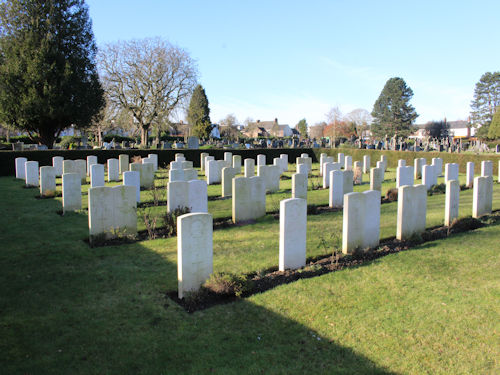
Private Thomas Walker Tortoishell was buried on 12th June, 1917 in Hatfield Road Cemetery, St. Albans, Hertfordshire, England – Soldiers Corner S.W. Division Grave No. F. 1.
From the burial report of Private Thomas Walker Tortoishell - Coffin was Polished Elm. Brass furniture. Cortege was proceeded by a firing party of the 3rd Vol. Batt. Hertfordshire Regt and was met at the cemetery by Mrs Tortoishell (Wife) Mrs L. Collett (Sister) and his daughter. The service was performed at the Cemetery Chapel by the Rev. Howarth W. Jones, Curate of St. Albans. The “Last Post” was sounded at the graveside by trumpeters of the 23rd Res. Training Batt. Wreaths were dent from Wife and children, sister and brother and daughter and nephew. Gun carriage was supplied by Hospital.
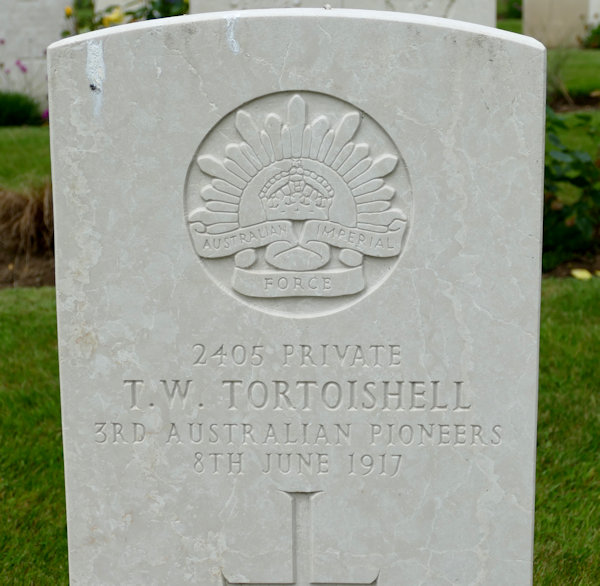
Private Thomas Walker Tortoishell’s burial place is now recorded by Commonwealth War Graves Commission as Plot number Mil. F. I. and now has a Commonwealth War Graves Commission headstone.
Private Thomas Walker Tortoishell was entitled to British War Medal only as he had not entered a Theatre of War. A Memorial Scroll & Memorial Plaque were also sent to Private Tortoishell’s mother – Mrs L. Tortoishell, as the closest next-of-kin (Even though details had been recorded regarding next of kin changing to his sister in May, 1917 due to the death of his mother. (Scroll & Plaque issued in England).
Acknowledgments
Gareth Hughes, Jonty Wild, Cathy Sedgwick, Beth Page - https://ww1austburialsuk.weebly.com/