Name
John Joseph Baynes
Conflict
First World War
Date of Death / Age
05/05/1917
Rank, Service Number & Service Details
Private
1005
Australian Infantry, A.I.F.
16th Bn.
Awards: Service Medals/Honour Awards
Not Yet Researched
Cemetery/Memorial: Name/Reference/Country
ST. ALBANS (HATFIELD ROAD) CEMETERY
Mil. D. 3.
United Kingdom
Headstone Inscription
Not Researched
UK & Other Memorials
Not on the St Albans memorials (*1)
Biography
John Joseph Baynes was born at Denniston, Glasgow, Scotland on 1st December, 1881 to parents John and Elizabeth Peters Baynes (nee Lennox).
According to information provided by his former wife for the Roll of Honour – John Joseph Baynes came to Australia when he was 20 or 22 years of age.
John Joseph Baynes married Edith Elizabeth Yehr/Fehr (as listed on Victorian BDM’s website) on 29th March, 1906 in Victoria.
A son – Dudley Leecroft Baynes was born in the district of Carlton, Victoria to parents John Joseph & Edith Elizabeth Baynes (nee Fehr). His birth was registered in 1908.
NSW Police Gazette and Weekly Record of Crime, Sydney, NSW – 24 April, 1907: Deserting Wives and Families
Victoria – A provisional warrant has been issued by the Water Police Bench for the arrest of John Joseph Baynes, charged with wife desertion in the State of Victoria. He is 25 years of age, 5 feet 3 inches high, slight build, dark eyes, fair complexion, dark-brown hair, thin on top, prominent forehead, clean shaved, small red mark on right cheek; dressed in a brownish tweed suit, green stripe running through material, and light Klondyke hat. Said to have been seen in George-street, Sydney, on the 11th instant.
The NSW Gaol Description and Entrance Books 1818 – 1930 has recorded a “John Baynes” born around 1881 in Scotland. He was aged 31 & had been admitted to Broken Hill Gaol on 10th August, 1912 for indecent Language. He had arrived in Australia on Ophir in 1898. His religion was Presbyterian with brown hair & brown eyes.
The South Australian Police Gazette – 8 October, 1913:
DESCRIPTION OF PRISONERS TO BE DISCHARGED FROM H.M. GAOLS During the week ending October 18th, 1913.
John Joseph Baynes, native of Scotland, 32 years of age, 5ft 5 in high, muscular build, dark-brown hair, dark-brown eye, swarthy complexion, clean shaven, mole on left cheek, star tattooed on inside of right forearm, tried at Mount Gambier on September 13th, 1913, for unlawful possession; one month.
John Joseph Baynes was aged 33 years & 10 months, divorced & a Labourer when he enlisted on 9th September, 1914 at Morphettville, South Australia with the Australian Imperial Force (A.I.F.). His service number was 1005 & his religion was Presbyterian. His next of kin was listed as his son – Dudley Baynes, South Melbourne, Victoria.
Private John Joseph Baynes was posted to 16th Battalion.
Private John Joseph Baynes embarked from Melbourne, Victoria on HMAT Ceramic (A40) on 22nd December, 1914 with the 16th Infantry Battalion “F” Company.
Private John Joseph Baynes was confined to the Bab-el-Hadid Guard Room at 10.50 pm on 17th February, 1915 Drunk. As a result he was to forfeit 2 days’ pay.
Private John Joseph Baynes proceeded to join M.E.F. (Mediterranean Expeditionary Force) at Gallipoli on 12th April, 1915 (from Alexandria).
Private John Joseph Baynes was admitted to 4th Field Ambulance at Gallipoli on 11th May, 1915– “no teeth requires super denture” (?)
Private John Joseph Baynes was admitted to Gascon with Neuralgia on 15th May, 1915. He was admitted to 17th General Hospital on 19th May, 1915 & discharged to duty at Convalescent Camp at Mustapha on 10th June, 1915. Private Baynes was transferred to 17th General Hospital from 1st Australian Overseas Base at Alexandria on 10th June, 1915. He embarked on HMT Achaia for Firing Line at Dardanelles on 14th June, 1915.
Private John Joseph Baynes was admitted to 1st Australian Casualty Clearing Station at Gallipoli with Acute Otitis Media. He was transferred to Fleet sweeper on 20th July, 1915. Private Baynes was transferred to Hospital Ship Galeka on 22nd July, 1915 suffering from general Debility.
[Fleet sweepers were vessels used to evacuate wounded & sick from Gallipoli to the Hospital Ships further out to Sea.]
Private John Joseph Baynes was admitted to No. 1 General Hospital at Heliopolis on 27th July, 1915 with Otitis.
Private John Joseph Baynes embarked from Alexandria on 22nd August, 1915 on Hunstgreen to join M.E.F. (Mediterranean Expeditionary Force). He rejoined his Unit at Lemnos from Gallipoli on 30th September, 1915
Private John Joseph Baynes reported sick on 30th September, 1915. He was admitted to 4th Australian Field Ambulance on Mudros West on 1st October, 1915 with Rheumatism. He was discharged to duty on 2nd October, 1915 & rejoined his Unit the same day.
Private John Joseph Baynes reported sick on 19th October, 1915. He was admitted to 4th Australian Field Ambulance at Sarpi Camp on 19th October, 1915 with Rheumatism. Private Baynes was admitted to No. 3 Australian General Hospital at Lemnos on 19th October, 1915. He was transferred & admitted to 27th General Hospital, R.A.M.C. at Mudros on 4th December, 1915 with Rheumatism. Private Baynes was transferred on to Hospital Ship Soudan on 26th December, 1915 & admitted to St. David’s Hospital at Malta the same day.
Private John Joseph Baynes was transferred to All Saints Convalescent Camp at Malta on 29th January, 1916 from St David’s Hospital then on 8th February, 1916 he was transferred & admitted to St. Paul’s Hospital at Malta suffering from Myalgia. Private Baynes was transferred to Ghain Tuffika (Convalescent Camp), Malta on 19th February, 1916.
Private John Joseph Baynes was transferred to St. George’s Hospital, Malta on 9th March, 1916. He was transferred to Hospital Ship Marama on 12th May, 1916 from Malta with Para Typhoid & admitted to 2nd Australian General Hospital at Alexandria on 16th May, 1916 with Enteric – slight. Private Baynes was transferred to No. 3 Auxiliary Hospital at Heliopolis on 21st May, 1916 with Enteric.
16th Battalion
The 16th Battalion AIF was raised from 16 September 1914, six weeks after the outbreak of the First World War. Three-quarters of the battalion were recruited in Western Australia, and the rest in South Australia. With the 13th, 14th and 15th Battalions it formed the 4th Brigade commanded by Colonel John Monash...
When the 4th Brigade arrived in Egypt it became part of the New Zealand and Australian Division. The 4th Brigade landed at ANZAC late in the afternoon of 25 April 1915.
A week after the landing the 16th was thrown into the attack on Bloody Angle suffering many casualties. From May to August the battalion was heavily involved in establishing and defending the front line of the ANZAC beachhead, and in August the 4th Brigade attacked Hill 971. The hill was taken at great cost, although Turkish reinforcements forced the Australians to withdraw. The battalion served at ANZAC until the evacuation in December.....
(Extract of Battalion information from the Australian War Memorial)
Private John Joseph Baynes proceeded overseas with 4th Training Battalion from Alexandria on 6th June, 1916 on H.T. Franconia.
Private John Joseph Baynes was transferred from Command Depot to Bhurtpore Barracks, Tidworth, Wiltshire, England on 21st July, 1916.
Reinforcements were only given basic training in Australia. Training was completed in training units in England. Some of these were located in the Salisbury Plain & surrounding areas in the county of Wiltshire. Later Training & Convalescing Units were combined under the one Command Depot.
Private John Joseph Baynes was written up by Camp Commandant at Tidworth, Wiltshire, England on 21st July, 1916 for being Absent without Leave from noon on 20th July, 1916 to 9 pm on 20th July, 1916. He was awarded 7 days confined to Barracks & forfeited 1 days’ pay.
Private John Joseph Baynes was admitted to Military Hospital at Tidworth, Wiltshire, England on 26th August, 1916 with Scabies.
Private John Joseph Baynes was admitted to The County of Middlesex War Hospital, Napsbury, St. Albans, Hertfordshire, England on 7th September, 1916 (as per Hospital Admissions Form). The Hospital Admissions form recorded “At first excited, exalted, boastful. Gradually became enfeebled mentally & paralytic.” (The Casualty Form – Active Service & Statement of Service form recorded Private Baynes was admitted to County of Middlesex War Hospital seriously ill on 1st March, 1917).
A Medical Report was completed on Private John Joseph Baynes on 26th January, 1917 while a patient at The County of Middlesex War Hospital, Napsbury, St. Albans. His disability was listed as General Paralysis of the Insane. Private Baynes stated “that he was at the Dardanelles and was in the Peninsula for about six months. Frequently under fire, and says that he was knocked out by an exploding shell. He was sent to Lemnos and then to Egypt; to England in Dec., 1916.” The cause of the disability was Syphilis – “Not caused but probably aggravated by stress of Active Service.” Private Baynes’ present condition was listed as “Mentally enfeebled; childish and fatuous. Memory defective. Babbles inconsequently....” The Officer in charge of the case stated that Private Baynes was temporarily unfit for home service or light duty & required a change to Australia. The Medical Board agreed.
Private John Joseph Baynes died at 12.15 pm on 5th May, 1917 at The County of Middlesex War Hospital, Napsbury, St. Albans. Hertfordshire, England from General Paralysis of the Insane.
A death for John Baynes, aged 34, was registered in the June quarter, 1917 in the district of St. Albans, Hertfordshire, England.
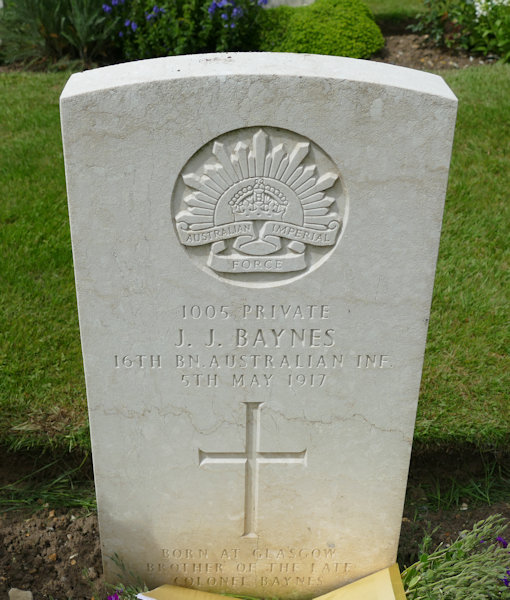
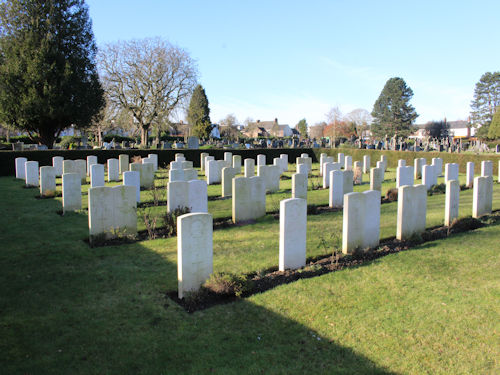
Private John Joseph Baynes was buried at 3 pm on 9th May, 1917 in Hatfield Road Cemetery, St. Albans, Hertfordshire, England – Plot number Mil. D. 3 Soldiers Corner and now has a Commonwealth War Graves Commission headstone. From the burial report of Private John Joseph Baynes - Coffin was good. Elm. The deceased soldier was buried with Military honours. Gun Carriage and Firing Party (National Volunteers) were in attendance. The “Last Post” was sounded at the graveside. The coffin was draped with the “Union Jack”. Prior to the interment a service was held in the chapel at St. Albans Cemetery. No relatives were present at the funeral. The St. Albans Borough Council have a Board of Honour erected and the names of each soldier buried is inscribed thereon.
The Red Cross Wounded & Missing file for Private John Joseph Baynes contains a letter from Captain, R.A.M.C., The County of Middlesex War Hospital, Napsbury, St. Albans regarding Private J. J. Baynes which reads: “In reply to your enquiry of the 25th inst., Pte Baynes was admitted to this Hospital suffering from a grave form of mental disorder. This was the result of progressive organic disease of the nervous system. He became steadily worse mentally and more enfeebled physically, and died in 5/5/17. The funeral, which was a military one, took place at St. Albans Cemetery on the 9th of May. He was buried in the Soldiers’ Corner.”
E. E. Baynes Kennedy, 39 Eastern Road, South Melbourne, Victoria, wrote to Staff Pay Master on 22nd June, 1917 in regards to Private J. J. Baynes, 1005 with the following: “My former Husband (I also being engaged & was to have remarried Him) wounder of otherwise so I waited He informed me He would aulter His next of Kin to myself as I had to support our Chile when (He) His Father should have done so. In letters received this year from Middlesex War Hospital He informes me He had done so Also that He had over £100 to bring home to me payable at pay office London. Could you inform me where he is buried. I have lived in England myself.”
Private John Joseph Baynes was entitled to 1914/15 Star, British War Medal & the Victory Medal. A Memorial Scroll & Memorial Plaque were also sent to Private Baynes’ son as the closest next-of-kin. (Scroll sent July, 1921 & signed for by Edith Baynes Parfett & Plaque sent November, 1922).
The British War Medal was signed for by “Dudley Baynes” on 19th July, 1921.
The Victory Medal (signed for September, 1922) & Memorial Plaque (signed for May, 1923) were signed for by Lewis Thomas, Secretary of Department for Neglected Children and Reformatory Schools. A letter was written to Base Records on 14th June, 1923 from Lewis Thomas, Secretary, in regards to the Victory Medal and Memorial Plaque being held in trust for Dudley Baynes, son of deceased Private J. J. Baynes, stating “I beg to inform you that the boy is now in the care of his mother, Mrs Parfitt, 26 Chessell Street, South Melbourne, although he is still under the legal control of this department. Have you any objection to the Medal and Plaque being hand over to the Mother?”
Base Records replied to The Secretary of Department for Neglected Children and Reformatory Schools, on 23rd June, 1923 advising that they had no objection to the Victory Medal & Memorial Plaque being handed over to Mrs Parfitt, mother of Master Dudley Baynes, however a Statutory Declaration was enclosed in the envelope for Mrs Parfitt to complete before a Justice of the Peace.
A further letter from Lewis Thomas, Secretary, dated 18th July, 1923, advised that the Victory Medal and Memorial Plaque had been handed over to Mrs Parfett.
Mrs E. E. Parfett, of 26 Chessell Street, South Melbourne, Victoria signed a Statutory Declaration on 18th July, 1923 that she “will preserve with due care, in trust for Master Dudley Baynes until such time as he becomes of an age when he can take them over for himself, any War Medals and other items given into my custody on account of the service of the late No. 1005 Private J. J. Baynes, 16th Battalion, Australian Imperial Force.”
Acknowledgments
Gareth Hughes, Jonty Wild, Cathy Sedgwick, Beth Page - https://ww1austburialsuk.weebly.com/